
Prediction for Nifty 50
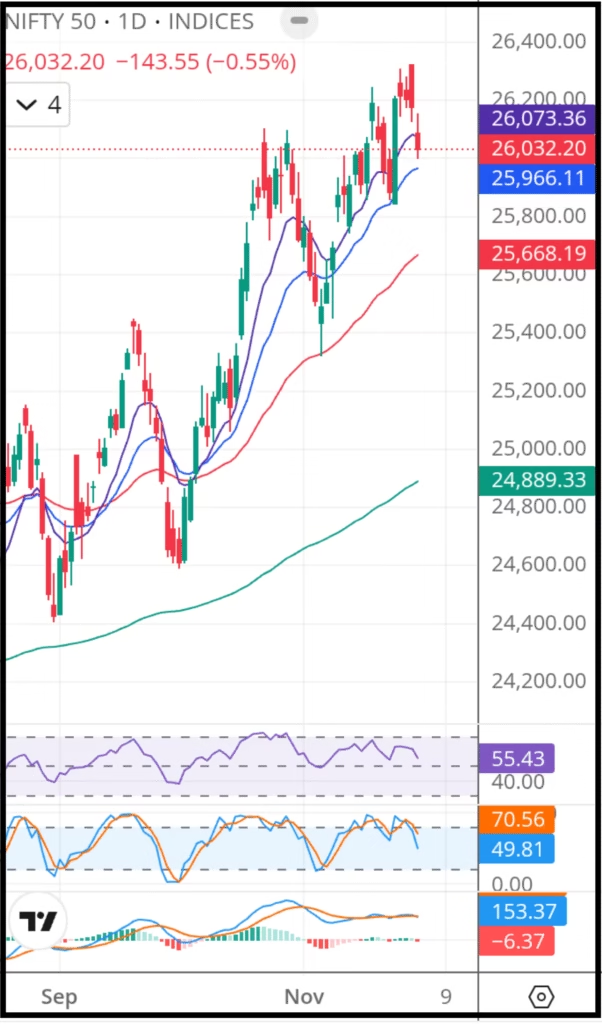
| Nifty 50 formed a Bearish Engulfing pattern in candlestick chart. Support Levels are at 26,000 and 25,850 and Resistance levels are at 26,200 and 26,325. The index is expected to consolidate at current levels.The Nifty declined on December 2, 2025, as traders booked profits after the index touched record highs in the previous session. Sentiment weakened further due to persistent FII selling and a sharp depreciation of the Indian rupee, which hit a new all-time low of 89.97 per US dollar. Banking and financial giants such as HDFC Bank, ICICI Bank, and Axis Bank dragged the index lower, while the pressure extended to the broader market, with both mid-cap and small-cap indices ending in the red. |
NIFTY 50 Mid-Week Prediction — Detailed Analysis
The Nifty 50 Mid-Week Prediction indicates a bullish market structure supported by strong domestic flows and stable global cues. In this detailed Nifty 50 Outlook, we analyse trend direction, key support levels at 26,000 and 25,338, major resistance zones at 26,277 and 26,500, and the expected target of 26,677. This technical analysis helps traders understand the market movement, identify buy-on-dips opportunities, and align with the overall positive momentum for the week.
The NIFTY 50 continues to remain in a strong uptrend even with minor intraday volatility. The overall structure is bullish as domestic flows stay strong, global cues remain steady, and sector rotation supports upward momentum.
Topics of Discussion
1. Market Structure — Trend & Momentum
- Higher-highs and higher-lows pattern intact
- Strong buying visible near dips around 26,000 zone
- Momentum indicators stable above mid-levels
- Midcaps and smallcaps stabilizing, supporting broader market health
2. Key Levels for Mid-Week
Strong Support Zones:
- 26,000 – major psychological level
- 25,338 – strong swing support
Resistance Zones:
- 26,277 – immediate resistance
- 26,500 – psychological barrier
- 26,677 – expected target for December 31
3. Global Market Influence
- US markets stable to positive with lower bond yields
- Crude oil near support – positive for India
- Dollar Index and INR steady – reduces currency risk
- India VIX remains within a comfortable range
4. Market Sentiment
- Strong domestic SIP + retail flows
- Reduced FPI outflows
- Consistent earnings support from heavyweight stocks
- Sector rotation keeping index well balanced
- Volatility controlled, no panic signals
5. Sector Performance
Strong Sectors:
- Auto
- Financial Services
- Metals
- PSU
Weak Sectors:
- IT – global tech weakness
- Pharma – selective buying only
6. Expected Mid-Week Movement
- Buying likely around 26,000–26,100 zone
- Upside movement toward 26,277–26,350
- Sustaining above 26,277 can push index to 26,450–26,500
- Sideways-to-positive bias expected
7. Trading Strategy
For Positional Traders:
- Buy near dips around 26,000
- Stop-loss: Below 25,900
- Targets: 26,277 → 26,350 → 26,500
For Intraday Traders:
- Prefer buying near support zones
- Avoid shorting unless Nifty breaks below 26,000
- Expect sideways but slightly bullish movement
8. December End Outlook
The expected December 31 target of 26,677 remains valid unless a major negative global trigger appears.
Factors Affecting Nifty 50 Performance
The Nifty 50 does not move randomly. Every rise and fall is like a chapter in a story shaped by many characters—some domestic, some global, and some completely unpredictable. Together, they decide whether the index climbs confidently or hesitates at every step.
The Domestic Story: India’s Own Forces at Play
Imagine the Indian economy as a city full of moving parts. At the centre stands the Reserve Bank of India, the guardian who adjusts the interest rates.
When it raises rates, money becomes expensive, businesses slow down, and the Nifty often loses energy. But a rate cut is like opening a tap—liquidity flows, spending increases, and the market suddenly feels more alive.
Inflation enters next, sometimes as a friendly companion, sometimes as a villain.
Mild inflation tells the world the economy is growing. But high inflation eats into profits, shrinks purchasing power, and immediately pressures the Nifty.
Then comes GDP—India’s heartbeat.
A strong GDP number is like a message to global investors: “India is thriving.” Money flows in, confidence rises, and the Nifty strengthens. But when GDP slows, market participants pull back, and bearish sentiment creeps in.
The biggest movers, however, are the institutional giants—FIIs and DIIs.
Their buying can lift the entire market in a single day, while their selling can trigger sharp declines. They are like tides that push the Nifty forward or pull it back.
Government policies add another twist to the story. A favourable policy, corporate tax cut, or reform can ignite excitement, while political uncertainty can cool the mood instantly.
And of course, different sectors play their own roles.
When heavyweights like finance, IT, or oil and gas perform well, the Nifty rallies. When they falter, even strong global cues struggle to lift the index.
The Global Story: The World’s Influence on Nifty
India may be growing fast, but the Nifty is still part of a much bigger global theatre.
Major indices like the S&P 500 often set the tone. If US markets fall sharply, the Nifty feels the shock almost immediately.
Foreign capital flows move in and out based on global sentiment.
When the world is optimistic, FIIs pour money into India. When fear rises abroad, they pull out funds—even if the Indian economy is stable.
Crude oil is another major character.
As a country that imports most of its oil, India suffers when prices rise; inflation increases, businesses face higher costs, and the Nifty usually turns weak.
Geopolitical events—wars, tensions, trade disputes—create uncertainty that touches every market, including India.
A sudden conflict can freeze investor confidence worldwide.
And then comes currency movement.
A weakening rupee makes imports costlier but boosts export earnings. This tug-of-war influences sectors differently and impacts the broader index.
Other Influential Characters in the Nifty Story
Corporate earnings act like reality checks.
Every quarter, results reveal whether companies are truly performing or simply riding sentiment. Strong earnings push the Nifty higher; weak earnings drag it down.
Then there’s investor behavior—the most emotional part of the story.
Fear, excitement, overconfidence, panic selling… even rumors can shake the market and create wild short-term swings.
Lastly, the unexpected characters appear—natural disasters, supply chain shocks, and sudden economic events.
They may not show up often, but when they do, they leave a mark.
Conclusion
The overall outlook for Nifty 50 continues to favour the bulls, and the market structure clearly reflects strength rather than weakness. Despite intraday volatility and short-term profit-booking, Nifty has consistently respected its higher-low formation and defended the 26,000 zone multiple times. This behaviour is typical of a market preparing for the next leg of upward movement rather than one entering a correction phase. The sustained buying from domestic investors, steady SIP flows, improving global cues, and sectoral rotation into strong pockets like Auto, Infra, PSU, and Metals indicate that institutional players are still positioned on the long side.
Even when global markets turn slightly negative, Nifty shows resilience and quickly recovers losses, proving that market sentiment remains firmly positive. At the same time, India’s macroeconomic environment—stable crude prices, controlled inflation, and a supportive currency—continues to offer a strong foundation for further index growth. Unless a major global shock emerges, Nifty is unlikely to break below its major support of 25,338, and the 26,000–26,100 demand zone is acting as a strong cushion for buyers.
Looking ahead into the rest of the week, the price action suggests a gradual move toward higher resistance levels of 26,277, 26,350, and eventually 26,500. A sustained breakout above these zones can attract fresh long positions and increase the probability of Nifty achieving its December 31 target of 26,677. For traders and investors, the logic remains simple: the market trend is up, momentum is positive, and dips continue to be bought aggressively. Therefore, the best strategy is to stay aligned with the broader trend, avoid premature shorting, and use every meaningful dip as an opportunity.
In conclusion, Nifty 50 is not showing signs of weakness but signs of consolidation within an uptrend. The combination of strong supports, healthy sentiment, positive global cues, and leadership from key sectors confirms that the index is well-positioned to continue its upward journey. Traders who remain patient, disciplined, and trend-aligned are likely to benefit the most from the ongoing market setup.
FAQ – Nifty 50 Mid-Week Prediction
1. What is the current trend of Nifty 50?
Nifty 50 is in a strong uptrend with higher-high and higher-low patterns intact.
2. What are the major support levels?
26,000 is the key psychological support, and 25,338 is the major swing support.
3. What are the resistance levels for this week?
Immediate resistance is 26,277, followed by 26,500 and 26,677.
4. What is the expected mid-week movement?
Nifty is likely to move toward 26,277–26,350 with a bullish bias as long as it holds above 26,000.
5. Should traders short Nifty?
No. Shorting is not advisable unless Nifty breaks below 26,000 with strong volume.
6. Which sectors are strong this week?
Auto, Infra, Metals, and PSU sectors show strong momentum.
7. What is the December 31 target?
The expected target remains 26,677.
Read More