
| Nifty begins the week with a wide resistance zone at 26,200–26,325 and key supports at 26,000 and 26,850. As long as the index holds above its support band, the short-term projection indicates a potential move toward 26,677–26,700, provided global cues and liquidity conditions remain supportive. |
Introduction
The Nifty50 enters the second week of December on a crucial note, with market participants closely tracking the combined impact of domestic economic momentum and evolving global geocommerce conditions. As inflation eases, liquidity improves, and global supply-chain adjustments reshape trade flows, the index continues to react sharply to both macroeconomic cues and sector-specific developments. The upcoming sessions from 8 to 12 December are expected to be influenced by movements in crude oil, currency fluctuations, FII–DII activity, geopolitical realignments, and demand conditions across major global economies.
This Nifty outlook provides a structured view of the key factors that may guide sentiment through the week. By analysing economic indicators, commodity trends, and international trade dynamics, this blog helps readers understand the forces shaping market behaviour and the potential directional bias for the index.
Topics of Discussion
Current Economic Developments in India
Equity benchmark indices, BSE Sensex and NSE Nifty, opened on a cautious note amid mixed global cues but gained strong upward momentum after the Reserve Bank of India (RBI) announced a 25-basis-point reduction in the repo rate to 5.25%. By the close, the Sensex stood at 85,712.37, rising 447.05 points(0.52%), while the Nifty50 settled at 26,186.45, up 152.7 points (0.59%).
The rate cut—unexpected in the context of robust Q2 GDP growth(8.2% in 2025)—combined with sharply lower inflation projections and supportive liquidity measures, fuelled broad-based buying across the market. Rate-sensitive segments such as automobiles, real estate, and NBFCs were among the strongest performers as the reduction in borrowing costs improved sentiment. Private banks also advanced on expectations of treasury gains, although concerns around net interest margins limited the extent of their rally. Sectorally, Nifty PSU Bank and Nifty Financial Services outperformed the broader indices.
Within the Nifty50 basket, 38 stocks closed in the green, with Shriram Finance, SBI, and Bajaj Finserv emerging as key gainers.
The broader outlook for the near term remains cautiously constructive, with markets expected to track corporate performance in the December quarter. However, risks such as a widening current account deficit, evolving global trade conditions, and uncertainty surrounding US Federal Reserve policy actions may influence trends in the weeks ahead.
Sentiment was further supported by the RBI’s announcement of Open Market Operation (OMO) purchases worth ₹1 lakh crore and a $5 billion buy/sell swap aimed at enhancing durable liquidity in the financial system.
With inflation easing sharply—from levels near 8% to close to 2%—and the FY26 growth projection raised from 6% to 7.3%, the central bank appears to be leveraging a favourable macroeconomic backdrop to stimulate domestic demand. The ongoing easing cycle is already prompting shifts in investor behaviour, particularly in interest-sensitive sectors. For investors, the environment calls for a reassessment of yield expectations and a rebalancing of portfolios, as softer interest rates may compress fixed-income returns and tilt preferences toward market-linked assets. While the policy impact may unfold gradually, market reactions tend to be swift, marking the early stages of a new phase in the monetary landscape.
India–Russia Strategic Engagement Strengthens
India and Russia reaffirmed their long-standing partnership by finalising a five-year plan to strengthen economic and trade cooperation, even as global geopolitical dynamics and tariff pressures evolve. During high-level discussions, both nations expressed the need to inject fresh momentum into their relationship, which spans more than eight decades.
In addition to endorsing the 2030 economic programme, the two sides concluded multiple agreements covering areas such as healthcare, mobility, and people-to-people cooperation. The leaders underscored the historic resilience of India–Russia relations, noting that the partnership has remained steady through periods of global uncertainty.
Both countries emphasised the importance of combating terrorism jointly and highlighted the strategic significance of collaboration in critical minerals, a sector vital for building secure and diversified global supply chains.
Russia noted that the priority areas for bilateral cooperation include security, economy, trade, and cultural ties. The two nations also outlined a shared goal of expanding annual bilateral trade to USD 100 billion, reflecting a renewed commitment to deepening economic engagement.
Key Levels for 8–12 December
Resistance Zone (Wide Range)
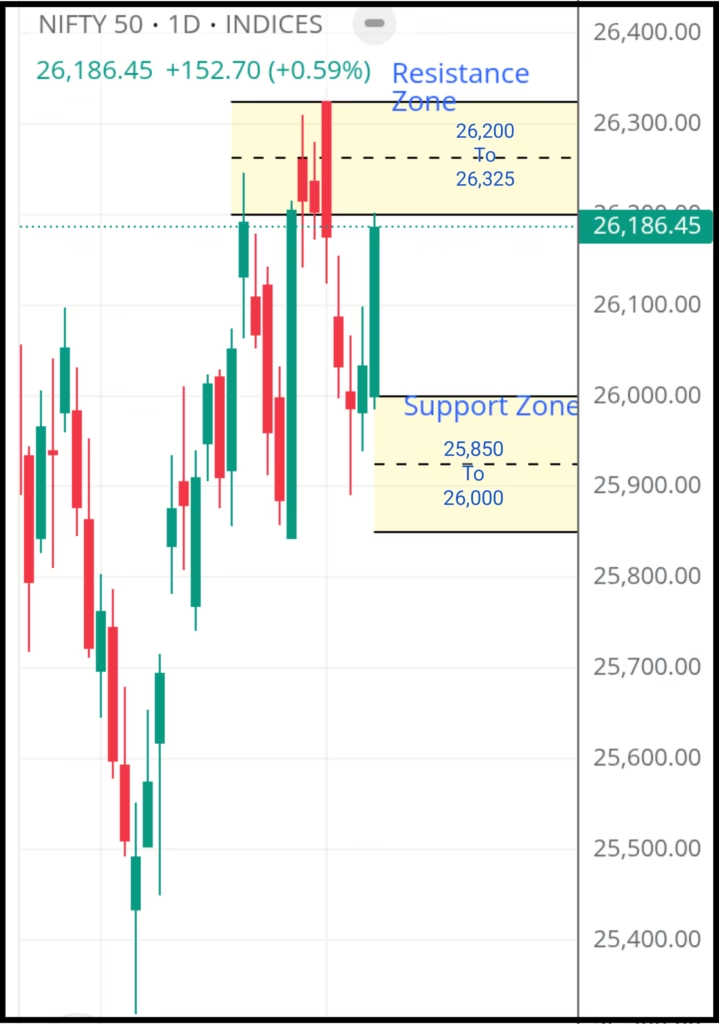
Nifty faces a broad resistance band between 26,200 and 26,325.
This zone is expected to act as a supply region, and sustained trade above 26,325 will be essential for a clear directional breakout.
Support Levels
Strong Support: 26,000
Secondary Support: 26,850 (important for intraday sentiment and short-term rebounds)
These levels will guide price action throughout the week and help identify potential reversal or continuation points based on market conditions.
Conclusion
The Nifty50 enters the week of 8–12 December with a defined trading structure shaped by economic indicators, global geo-commerce trends, and liquidity conditions. The index currently faces a wide resistance zone between 26,200 and 26,325, a region that has repeatedly triggered supply in recent sessions. On the downside, 26,000 remains a critical support level, while 26,850 acts as secondary support that helps maintain short-term stability when volatility spikes.
With easing inflation, supportive macro data, fluctuating crude oil prices, and shifting global trade dynamics, market behaviour is expected to remain sensitive to both domestic flows and international cues. This outlook examines how these factors may influence Nifty’s directional bias throughout the upcoming sessions.
Frequently Asked Questions (FAQ)
1. What is influencing the Nifty movement for 8–12 December?
Nifty movement this week is shaped by inflation trends, crude oil prices, currency fluctuations, global market sentiment, and trade-related geopolitical developments.
2. How do geo-commerce trends impact the Indian market?
Geo-commerce trends—such as global supply-chain shifts, export–import changes, and regional trade agreements—affect sectoral performance and overall market risk appetite.
3. Are FIIs expected to play a major role this week?
Yes. FII activity remains crucial, as inflows support market strength while persistent selling can create short-term pressure on index levels.
4. What sectors are likely to outperform in the second week of December?
Sectors benefiting from lower input costs, stable demand, and favourable global cues—such as IT, financials, and consumption—may show relative strength depending on macro trends.
5. How should traders approach the market this week?
A cautious approach is advisable: track global cues closely, follow support–resistance levels, and adjust positions based on volatility and institutional flow patterns.
6. Why is the 26,200–26,325 zone considered a wide resistance range?
This zone has witnessed repeated profit booking and supply pressure, making it difficult for the index to sustain a breakout. The broader the range, the stronger the confirmation required for Nifty to push higher with conviction.
7. Why are the 26,000 and 26,850 levels important for support?
The 26,000 level is a psychological and technical support that stabilises overall sentiment. The 26,850 level acts as a secondary floor, helping the market absorb intraday volatility and maintain short-term structure.
Read More