

Performance of Dow Jones Industrial Average
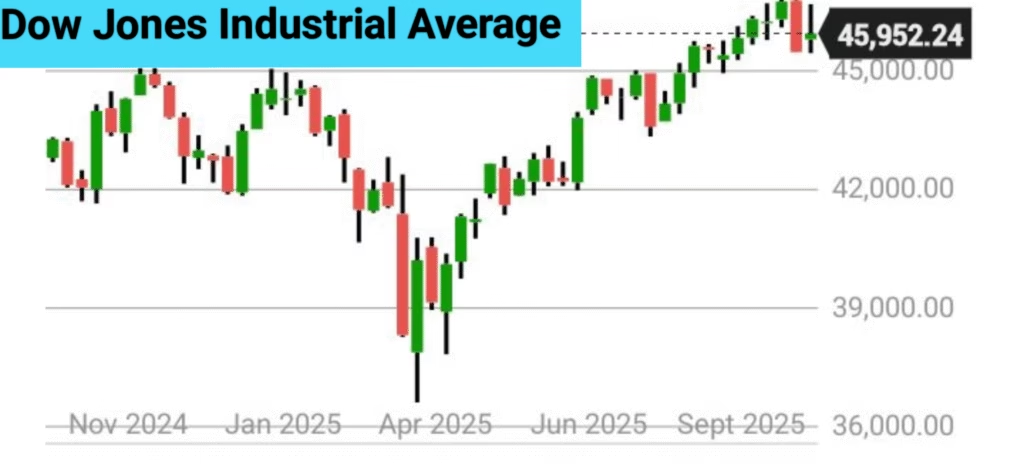
The Dow Jones Industrial Average has seen a fluctuating performance this week, ending on October 16, 2025, at 45952.24. As of October 15, the Dow closed at 46,253.31, representing a decline of 0.04%. Throughout the week, the index has experienced both upward and downward swings.
On Thursday, October 16, bank stocks led declines, and the Dow lost 301.07 points, or 0.65%, giving up earlier gains. The previous day, October 15, the index closed slightly lower. Looking at the full trading week, from its opening on Monday, October 13, at 45,698.09, to its latest reported trading on Thursday, October 16, the Dow has shown mixed results, influenced by factors like trade tensions, earnings reports, and concerns about bad loans in the banking industry.
Topics of Discussion
A Snapshot of US Stock Market
Here’s a snapshot of how the major indices closed:
| Index | Close | %Change |
| Dow Jones | 45952.24 | -0.65 |
| Nasdaq Composite | 22562.54 | -0.47 |
| S&P 500 | 6629.07 | -0.63 |
Technical Analysis of Dow Jones Industrial Average
Here is a technical overview of the Dow Jones Industrial Average based on data up to October 16, 2025. Please note that technical analysis focuses on past price movements to predict future trends
Resistances and Supports Table
| Close | 45,952.24 |
| Resistances | Levels |
| 1 | 46622 |
| 2 | 47288 |
| 3 | 47525 |
| Supports | Levels |
| 1 | 45905 |
| 2 | 45510 |
| 3 | 45302 |
Moving Average Table
| Period (Days) | Simple | Exponential |
| 5 | 46004 | 46155 |
| 10 | 46303 | 46191 |
| 20 | 46300 | 46170 |
| 50 | 44631 | 44886 |
| 100 | 44631 | 44886 |
| 200 | 43451 | 43721 |
Oscillator Table
| Indicator | Vaue | Inference |
| RSI(14) | 47.85 | Neutral |
| Stoch (9,6) | 97.42 | Overbought |
| MACD (12,26) | 130.65 | Buy |
| ADX | 21.28 | Neutral |
Insights
Technical Indicators: The current trend is strongly bullish, supported by moving averages, but caution is advised due to overbought conditions indicated by the Stochastic indicators, potentially signaling a short-term correction.
Current Price: 45952.24 as of October 16, 2025.
Key Resistance: Resistance is identified in the 46,622 – 47288 area. A break above 47288 could signal further gains towards 47525.
Key Support: Failure to breach the resistance levels could lead to a decline towards 45905. A break below 45510 would increase selling pressure, potentially pushing the index down to 45302.
Trading Range: The index is currently experiencing an bullish outlook, likely trading within a range of 46622-45905. A breakout from this range is crucial to determine the next significant move.
Analysts and Top Institutional Investors View
According to analysts and market reporters on October 16, 2025, the view on the Dow Jones Industrial Average is cautiously optimistic, influenced by strong corporate earnings in the AI and tech sectors and the prospect of a soft economic landing, despite ongoing market volatility and U.S.-China trade tensions. Top institutional investor sentiment is shifting towards bonds and other reliable income sources due to declining interest rates, yet many are still active in equities and buying the dip.
Analyst and market commentary on the Dow Jones Industrial Average:
- Market reporters indicate that the Dow, along with other major indices, advanced on October 16, 2025, driven by strong quarterly earnings from major banks and technology firms.
- Analysts note that investors are focusing on corporate profits that have exceeded expectations, especially in the AI-driven tech sector.
- While investors are looking past recent trade escalations and a federal government shutdown, analysts expect markets to remain volatile.
- Some analysts see potential for continued market strength into 2026 if upcoming economic data supports a soft landing scenario.
- Early trading on October 16 showed the Dow lagging behind the S&P 500 and Nasdaq Composite, which saw larger gains fueled by tech stocks.
Institutional investor sentiment:
- Recent market reports highlight a shift in institutional investor sentiment, with many moving toward fixed-income instruments, such as government and corporate bonds, as a reliable source of income.
- The move towards bonds is partly a response to anticipated interest rate cuts by central banks, which can make locking in current yields attractive.
- Despite this shift, retail traders have been very active in the equities market, aggressively buying dips during volatile periods, which can also influence broader market dynamics.
- The market’s resilience despite volatile conditions and rising trade tensions suggests continued, albeit cautious, institutional participation in equities, particularly in sectors showing strong growth like AI and technology.
Also Read


Factors Affecting the Performance of Dow Jones Industrial Average
The Dow Jones Industrial Average (DJIA) is primarily influenced by macroeconomic factors, the performance of its 30 component companies, geopolitical events, and investor sentiment. As a price-weighted index, the stock price of each constituent company, rather than its market capitalization, determines its impact on the DJIA’s movement.
Key economic factors:
- Interest rates: A rise in rates increases borrowing costs for companies, which can cut into profits and put downward pressure on stock prices. Conversely, lower interest rates can stimulate borrowing and potentially boost company earnings and the market.
- Inflation: High inflation erodes purchasing power, which can reduce corporate profitability and drive down the market. While inflation often has an inverse relationship with stock markets, moderate, controlled inflation can be a sign of a healthy economy.
- Gross Domestic Product (GDP): A rising GDP indicates a growing economy and gives investors confidence that companies will perform well, often leading to a rising market. A contracting GDP can have the opposite effect.
- Unemployment rate: A lower unemployment rate signals a strong economy and can lead to higher consumer spending and corporate profits. A high unemployment rate suggests economic weakness and can negatively impact stock prices.
- Retail sales: As a consumer-driven economy, strong retail sales indicate healthy consumer demand, which generally leads to a positive market. Weak sales can signal a downturn.
Component company performance:
- Earnings reports: The collective performance of the 30 major companies comprising the DJIA has a direct impact on the index. Positive quarterly earnings reports can boost the index, while disappointing results can cause a decline.
- High-priced stocks: The price-weighted nature of the DJIA means that changes in the stock price of a high-priced component, such as UnitedHealth Group or Goldman Sachs, can disproportionately affect the index’s movement.
- Index changes: The DJIA’s components are regularly reviewed and updated by a committee. Companies can be added or removed based on market relevance and overall performance, which ensures the index continues to be a relevant representation of the U.S. economy.
Geopolitical events and market sentiment:
- Trade tensions and tariffs: Imposing tariffs or engaging in trade wars, particularly with major trading partners like China, can disrupt supply chains, increase costs for companies, and create market volatility.
- Investor sentiment: Overall market psychology—whether investors are bullish (optimistic) or bearish (pessimistic)—drives the market. This can be influenced by economic reports, corporate news, and global events.
- Major events: Significant global events, including wars, pandemics (like COVID-19), and terrorist attacks, can create uncertainty and lead to sharp market downturns.
- Commodity prices: Since the DJIA includes companies from the energy and industrial sectors, it can be sensitive to price fluctuations in commodities like crude oil.
Disclaimer
The information provided on this website is for educational and informational purposes only. It should not be considered as financial, investment, or trading advice. The views and analyses expressed are based on publicly available data and personal research and are not recommendations to buy, sell, or hold any securities.
Investing in the stock market and mutual funds involves risks, including the possible loss of principal. Past performance is not indicative of future results. Readers are encouraged to conduct their own research or consult a qualified financial advisor before making any investment decisions.
The website owner and authors shall not be held liable for any direct or indirect losses arising from the use of the information provided here. By using this site, you agree that you are solely responsible for your investment actions.