
Introduction
Rail Vikas Nigam Limited (RVNL), incorporated in 2003 is an Indian central Public Sector Undertaking (PSU). It serves as the construction and project implementation arm for the Ministry of Railways. The objective of the company is to meet India’s growing infrastructure needs, particularly to fast-track railway projects. RVNL a “Navratna” PSU company is responsible for developing and modernizing India’s rail infrastructure and is now diversifying into other sectors.
Topics of Discussion
RVNL’s Operation and Services
RVNL offers comprehensive infrastructure development and project management services. Its business is built on executing railway and other infrastructure projects on a turnkey basis, from initial concept to final commissioning.
Infrastructure development
RVNL’s core services include a wide array of railway construction and development projects:
New railway lines:
Construction of new rail tracks to expand the network and improve connectivity.
Track doubling and electrification:
Upgrading single railway lines to double lines and electrifying them to enhance capacity and efficiency.
Gauge conversion:
Converting existing railway tracks from one gauge to another to ensure network uniformity.
Mega bridges:
Construction of major bridges, including cable-stayed and monumental bridges, to overcome obstacles like rivers.
Metro projects:
Execution of metropolitan transport systems to improve urban connectivity.
Production units and workshops:
Establishment of new facilities for manufacturing railway equipment, such as the Vande Bharat Express, and modernizing existing ones.
Station modernization:
Renovation of railway stations to provide better passenger amenities and services.
Port connectivity:
Implementing rail links to major ports to streamline the movement of goods.
International projects:
Involvement in rail and other infrastructure projects in other countries, such as Kyrgyzstan.
Specialized services
In addition to construction, RVNL provides a suite of specialized services to support its projects:
Project management:
RVNL manages the entire project lifecycle, from planning and execution to quality assurance.
Consultancy:
The company offers consultancy services, including conducting feasibility studies and preparing detailed project reports for railway projects.
Signaling and telecommunications:
This includes the installation and maintenance of electronic interlocking systems, train control systems, and communication networks for safe and efficient train operations.
Resource mobilization:
RVNL is tasked with raising extra-budgetary resources for projects by creating Special Purpose Vehicles (SPVs), which are funded through a mix of equity and debt.
SWOT ANALYSIS:
The pros and cons of RVNL Cover its strengths, weaknesses, opportunities, and threats.
For an infrastructure Public Sector Undertaking (PSU) like Rail Vikas Nigam Limited (RVNL), its strengths, weaknesses, opportunities, and threats (SWOT) are closely tied to government policies, the financial health of the Ministry of Railways, and the broader economic climate
Strengths
Assured revenue visibility:
As the primary project execution arm of the Ministry of Railways (MoR), RVNL has a robust and predictable pipeline of projects. This ensures strong, long-term revenue visibility, insulated from market fluctuations that affect private players.
Low-risk business model:
RVNL operates on a “cost plus margin” model, meaning its profit margins are largely fixed by the MoR. This protects it from cost overruns and execution risks inherent in large-scale infrastructure projects.
Strong government backing:
Being a PSU, RVNL is fully supported by the Government of India and the MoR. This support, including facilitated funding and assistance with land acquisition, provides significant operational stability.
Asset-light operations:
RVNL outsources many construction tasks to contractors. This strategy keeps its fixed assets and operational costs low, allowing it to remain agile and scale up or down as project loads change.
Diversification into new areas:
The company is successfully diversifying its projects beyond Indian Railways into other sectors like metro rail, highways, and international markets. This broadens its revenue base and reduces over-reliance on a single client.
Weaknesses
Heavy reliance on Indian Railways:
The company is overly dependent on the MoR for projects, which are directly tied to the annual budget allocations. Any reduction in railway capital expenditure could significantly impact RVNL’s order book and growth.
Approvals and sanctions dependency:
RVNL’s project timelines can face delays due to lengthy bureaucratic processes for obtaining approvals for revised estimates, designs, and safety sanctions from the MoR.
Lower profitability margins:
Because its margins are fixed by the government, RVNL has less control over profitability, which can be lower compared to private sector counterparts. Recent quarterly results have shown margin compression driven by a weaker revenue mix.
Operational delays:
Factors outside of RVNL’s control, such as land acquisition issues, clearances, and operational traffic blocks, can cause significant project delays.
Human resources:
Concerns about manpower, including attracting and retaining top talent with competitive salaries and the prevalence of contractual staff, are significant weaknesses for the company.
Opportunities
Robust national rail plan:
The government’s ambitious National Rail Plan aims for 100% electrification, multi-tracking of congested routes, and modernization of the network. As the government’s key implementing agency, RVNL is set to benefit from this long-term investment plan.
Domestic diversification:
RVNL can continue to expand its footprint in non-railway infrastructure projects, such as metro rail systems, port connectivity, and road infrastructure, capitalizing on India’s overall infrastructure push.
Expansion into international markets:
RVNL has experience working with multilateral bodies like the Asian Development Bank (ADB) and has undertaken projects abroad. This expertise presents opportunities to secure more infrastructure projects in other countries.
Execution of high-speed rail:
With a subsidiary focused on high-speed rail, RVNL is well-positioned to implement future high-speed corridors in India as the government rolls out new projects.
Innovative financing models:
The use of Special Purpose Vehicles (SPVs) to mobilize extra-budgetary resources for projects and leveraging Public-Private Partnerships (PPPs) can help RVNL increase its execution capacity without straining its own balance sheet.
Threats
Policy and funding risks:
Any change in government policy or a reduction in budget allocations to the railways would directly and severely impact RVNL’s business. Furthermore, delays in receiving outstanding payments from the government are a concern.
Intense competition:
While its core business is insulated, RVNL faces increasing competition from other domestic and international players for non-nominated and international projects, which could pressure margins.
Execution challenges:
In addition to land acquisition, other on-the-ground issues, such as safety concerns on existing train lines and law and order problems in certain regions, pose risks to project execution.
High valuation:
The stock has seen a rapid run-up in price, leading to an elevated Price-to-Earnings (P/E) ratio relative to its fundamentals. This high valuation is vulnerable to market and execution risks, making it less attractive for some investors.
Supply chain issues:
While RVNL uses an asset-light model, it remains dependent on contractors. Any issues with the contractor supply chain or material availability could cause project delays and impact profitability.
Fundamental analysis:
Rail Vikas Nigam Limited’s (RVNL) fundamental analysis reveals a history of consistent financial growth supported by a stable government-backed business model
However, its financial performance has become volatile more recently. The company’s valuation metrics are currently expensive compared to its peers.
Revenue growth
RVNL has historically maintained steady revenue growth driven by its role as a project implementation arm for the Indian Railways. The company’s business model relies on a flow of projects awarded by the Ministry of Railways (MoR).
Revenue for the fiscal year ending March 2025 was ₹19,923 crore, an 8.94% decrease from the ₹21,878 crore reported in FY24.
This decline was also seen in its quarterly results, with revenue falling 4.6% year-over-year in the first quarter of fiscal year 2026.
Over the past five years, the company has delivered an average annual sales growth of around 6.5%, which is considered modest.
Profitability
The company’s “cost-plus-margin” business model provides stable but comparatively lower profitability margins than some private-sector counterparts.
Net Profit:
Profit after tax has seen recent volatility. It decreased to ₹1,186 crore in March 2025 from ₹1,470 crore in March 2024, a drop of over 17%. This trend continued into Q1 FY26, with net profit falling 40% year-on-year.
Margins:
Profit margins have also shown a declining trend recently. The net profit margin was 6.43% for FY25, down from 7.09% in FY24.
Return Ratios:
Return on Equity (ROE) was 14.01% and Return on Capital Employed (ROCE) was 14.74% in FY25. These figures are solid but lower than the FY24 returns.
Debt
Historically, RVNL has maintained a low-leverage model, with much of its debt being serviced by the Ministry of Railways.
The company has been actively reducing its total debt-to-equity ratio over the past few years.
As of March 2025, the consolidated debt-to-equity ratio was 0.57, indicating a healthy level of financial leverage.
The company has an interest coverage ratio of 11.8x, showing that its operating income can comfortably cover its interest payments.
Financial ratios and valuation:
Valuation Ratios:
RVNL currently appears overvalued based on standard valuation metrics when compared to its historical averages and industry peers.
Price-to-Earnings (P/E) Ratio:
As of early October 2025, RVNL’s P/E ratio was around 60.6, significantly higher than the P/E ratios of many of its peers in the construction industry.
Price-to-Book (P/B) Ratio:
Similarly, at 7.56x its book value in early October 2025, the stock appears expensive.
Liquidity Ratios:
RVNL’s liquidity position remains healthy, with a current ratio of 2.06 as of September 2025. This indicates the company is well-equipped to meet its short-term liabilities.
Operational Efficiency:
The company has an efficient cash conversion cycle of 23.84 days, and its CFO/PAT (Cash Flow from Operations to Profit After Tax) ratio of 1.02 over the last five years indicates sound cash flow management.
Fundamental Analysis insights:
RVNL’s fundamentals present a mixed picture. The company has a strong, government-supported business model with a predictable, long-term order book. Its low-risk structure and improving debt profile are positive points.
However, the recent moderation in revenue and profit growth, as seen in the quarterly and annual results for FY25 and Q1 FY26, is a concern. The current high valuation, especially the P/E ratio relative to its peers, suggests that future growth is already priced into the stock, and it could be sensitive to any negative news. Investors should weigh the company’s strong government backing and future prospects against its recent underperformance and high valuation.
Technical Analysis:
A technical analysis of Rail Vikas Nigam Limited (RVNL) in October 2025 shows a mixed technical outlook. The stock is currently in a consolidation phase following a previous uptrend but is facing near-term weakness. While long-term moving averages remain positive, more recent performance and a potential overbought condition suggest caution
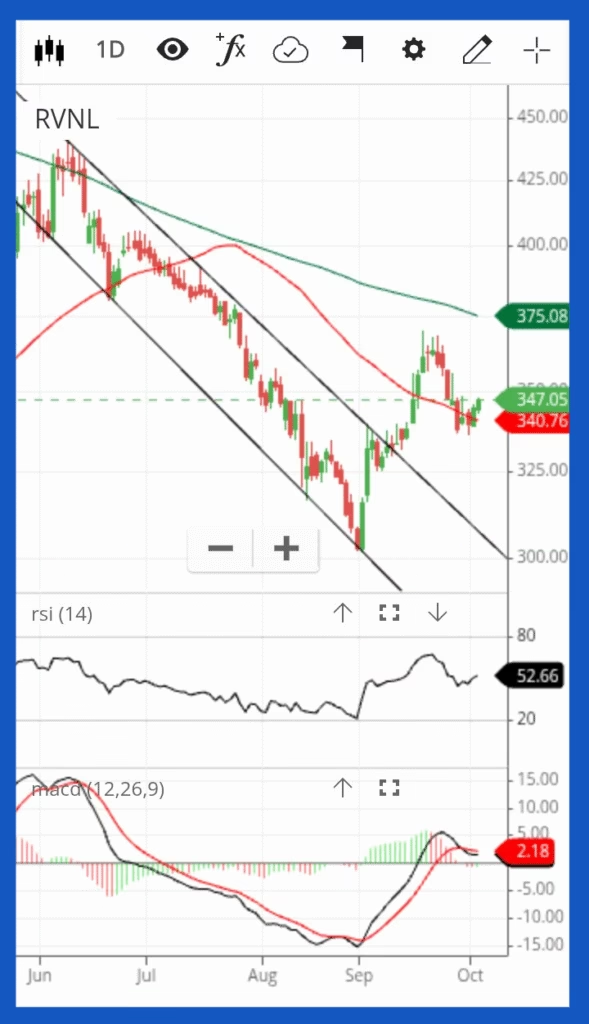
Chart Source: Zerodha Kite
RVNL Technical Insight
RVNL has broken out of the descending channel, signaling the end of its short-term downtrend. After a brief pullback, the stock is showing signs of renewed upward momentum.
Moving Averages:
The price has crossed above the 50-day moving average (red line) and is approaching the 200-day moving average (green line), which often indicates the beginning of a stronger bullish phase if sustained.
MACD Indicator:
The MACD line is above the zero line, confirming positive momentum and suggesting that the uptrend remains intact.
RSI (Relative Strength Index):
The RSI is above 50, showing strength and buying pressure, along with signs of positive divergence, which often precedes further upward movement.
📊 Overall View:
RVNL appears to be entering a bullish phase after a corrective pullback. Sustaining above ₹340–₹347 could lead to the next resistance around ₹360–₹368.
Price trend
Long-term trend (Bullish in Monthly Chart):
The stock remains in a long-term bullish trend, supported by its positioning above both its 50-day and 200-day Simple Moving Averages (SMA) in Monthly Chart. Daily chart can’t give the right picture of long term trend.
Short-term trend (Neutral):
In recent weeks, RVNL has shown some signs of strength but not completely recovered from losses. But the good news is the stock is trading above 50 day moving average. The stock fell substantially in late August and early September 2025, from around ₹358–₹360 to a low of ₹301.60.
Near-term trend (Consolidation):
After hitting its recent low, the stock has rebounded and is now in a period of consolidation. The price is trading sideways within a defined range, fluctuating between roughly ₹335 and ₹347 over the past few weeks.
Support and resistance levels
Resistance Levels:
Near-term Resistance:
A minor resistance level is observed around ₹347–₹348, which the stock has struggled to break decisively in late September and early October 2025.
Major Resistance:
A significant resistance level exists at the previous high of around ₹360–₹368. A breakout above this level would signal a continuation of the previous uptrend.
Support Levels:
Near-term Support:
The stock has established a near-term support level in the ₹335–₹337 range, which has held during the recent consolidation.
Major Supports:
The 50-day Simple Moving Average (SMA) around ₹345.16 can act as a crucial support level. The 200-day SMA, currently around ₹338.21, serves as a stronger, long-term support level. A breakdown below this could signal a reversal of the long-term trend.
Moving averages
50-day SMA:
Around ₹340.76. The stock is currently trading slightly above this moving average, indicating a short-term bullish signal within the broader trend.
200-day SMA:
Around ₹375.08 RVNL is currently trading below this crucial long-term average, reinforcing the overall bullish outlook, despite recent volatility.
Technical indicators
Relative Strength Index (RSI):
The 14-day RSI is at 52.66, placing it in a neutral zone. This suggests the stock is neither overbought nor oversold and has room to move in either direction.
Moving Average Convergence Divergence (MACD):
The MACD line is above the signal line, suggesting a positive momentum, and is also above the zero line. This indicates a bullish outlook and that recent short-term negative movement may be reversing.
Candlestick patterns:
Recent trading has produced a mix of bullish and bearish candlestick patterns, reflecting the current consolidation phase. The green candle on October 1, 2025, suggests buying interest, but this was preceded by red candles, indicating selling pressure.
Patterns and interpretation
The most relevant pattern for RVNL at present is sideways consolidation, with the stock trading in a range between the recent low of around ₹335 and the resistance at ₹347. This follows a period of significant volatility and a corrective phase after the stock’s previous high.
This consolidation can be interpreted in two ways:
Continuation of the uptrend:
The sideways movement may be a pause before the stock continues its long-term rally. A decisive breakout above the ₹347–₹348 resistance level, accompanied by high volume, could confirm this scenario.
Distribution Phase:
Alternatively, it could signal a distribution phase where long-term holders are selling off their positions. A breakdown below the support levels of ₹335–₹337 could confirm this more bearish scenario and lead to a deeper correction.
View of Top Investors and Analysts:
Top investors and market analysts hold a complex view of Rail Vikas Nigam Limited (RVNL), balancing its strong government-backed fundamentals against recent volatile performance and a high stock valuation. The general consensus, influenced by the company’s status as a Navratna PSU, leans toward a positive long-term outlook, but short-term concerns remain.
Institutional holdings
RVNL has a significant state or government ownership, which provides stability but also means investment decisions are heavily influenced by the government.
Promoters:
As of June 2025, the Government of India holds a substantial majority stake of 72.84%, reflecting the company’s strategic importance.
Foreign Institutional Investors (FIIs):
FII holdings experienced growth until early 2025 but showed a slight dip in the June 2025 quarter, standing at 4.89%.
Domestic Institutional Investors (DIIs):
DII holdings have fluctuated, settling at 6.38% in the June 2025 quarter. This group, particularly mutual funds, is being watched closely, as RVNL was recently moved from the mid-cap to the large-cap category, which could increase DII investment.
Mutual Funds:
Mutual fund holdings in RVNL are small, at around 0.18% as of June 2025, and have been decreasing in recent quarters.
Insurance Companies:
Life Insurance Corporation of India (LIC) holds a significant position within the institutional category, with a 6.06% stake as of June 2025.
Expert opinions and analysis
Analyst opinion on RVNL is divided, with some advising caution due to valuation and recent results, while others see a long-term growth opportunity backed by government policy.
Bullish outlook and key arguments
Strong Government Backing and Order Book:
Most experts recognize the company’s solid foundation due to consistent government support and its massive order book, which provides strong revenue visibility for several years.
Expansion and Diversification:
Recent ventures, such as the MoU with a Dubai-based firm to explore infrastructure opportunities in GCC countries, are seen as positive steps toward broadening its revenue base beyond Indian Railways.
Long-Term Sectoral Growth:
Analysts are optimistic about the long-term prospects of India’s railway infrastructure sector and believe RVNL, as a key PSU, is well-positioned to benefit from government investments and expansion plans.
Buy on Dips:
Following RVNL’s pullback from its 2024 highs, some experts have recommended a “buy on dips” strategy, particularly for long-term investors, citing healthy fundamentals and government focus.
Bearish outlook and key arguments
Overvaluation:
Many market analysts view the stock as overvalued relative to its earnings and historical valuation multiples. The high price-to-earnings (P/E) ratio is a primary concern.
Disappointing Recent Performance:
Recent quarters, particularly Q1 FY25, have shown a decline in both revenue and consolidated net profit, which has disappointed the market and prompted some profit-taking.
Dependence on Budget and Government:
A core concern is RVNL’s reliance on government budget allocations. Any reduction in railway capital expenditure could negatively impact its project pipeline.
Sell Recommendation:
In July 2025, analysts tracking the stock had a consensus “Sell” rating, with an average target price suggesting a potential downside from current levels.
Analyst recommendations vary based on different time horizons and risk tolerance.
Short-term:
For short-term traders, recommendations have been mixed, with some suggesting caution or a “sell-on-rise” approach due to the stock’s consolidation and recent volatility.
Medium- to long-term:
For investors with a longer time horizon, a “hold” or “buy on dips” strategy is more common, based on the company’s strong government backing, healthy order book, and diversification efforts.
Target Price:
Specific price targets vary among analysts. For instance, in August 2025, IDBI Capital issued a “Hold” recommendation with a target of ₹340. Separately, an analyst from LKP Securities set a near-term target of ₹370–₹380 in late September 2025. However, some analysts view the stock as overvalued, with a consensus target price suggesting potential downside.
Price Target of Smart Investello Research and Analysis
Short Term Target (3 months)- ₹370 – ₹400
Intermediate Term Target (1 Year ) – ₹500- ₹550
Long Term Target (3 Years) – ₹700- ₹900
Key growth drivers and risks for RVNL over the next 3–5 years
Key growth drivers and risks for Rail Vikas Nigam Limited (RVNL) over the next 3 to 5 years are tied directly to government policy, the state of the Indian economy, and the company’s strategic diversification efforts
Strong government support:
As a “Navratna” Public Sector Undertaking (PSU) and the executing arm of the Ministry of Railways (MoR), RVNL is a prime beneficiary of government initiatives and significant budget allocations toward railway infrastructure development. This ensures a steady pipeline of projects.
Massive order book:
As of August 2025, RVNL had a substantial order book exceeding ₹1,010 billion. This provides strong revenue visibility and operational security for the coming years.
National railway expansion plans:
RVNL is set to benefit from India’s long-term railway expansion, which includes new lines, doubling tracks, and electrification. Key government initiatives, such as the National Rail Vikas Yojana, provide a stable flow of new projects.
Diversification into new sectors:
RVNL has been actively diversifying its business beyond traditional railway projects, entering new infrastructure sectors like metro projects, highways, and irrigation. This strategy reduces dependence on a single client and expands revenue streams.
International expansion:
The company is pursuing international projects, including a recent Memorandum of Understanding with a Dubai-based firm to explore opportunities in the Gulf Cooperation Council (GCC) countries. This could provide access to new markets and higher-margin projects.
Modernization and innovation:
RVNL is involved in modernizing Indian Railways with projects like the manufacturing and maintenance of Vande Bharat trains. This positions the company to capitalize on technological advancements and upgrade projects.
Risks and challenges
Dependence on government policy:
The company’s business is highly influenced by government decisions, budget allocations, and shifts in policy. Any change in the government’s stance toward rail infrastructure spending could significantly impact RVNL’s project pipeline and profitability.
Increasing competition:
With the government now favoring competitive bidding over nomination for projects, RVNL faces rising competition from private sector players, which could put pressure on its profit margins.
Margin pressures and execution risks:
As RVNL moves into non-railway projects, it faces higher margin and execution risks. Some analysts suggest that moving into diverse sectors might cause the company to “spread itself too thin,” increasing operational complexity and risk.
Commodity price volatility:
Fluctuations in the prices of key raw materials like steel and cement can significantly impact RVNL’s costs and, therefore, its profitability. While some projects are cost-plus, competitive bids leave the company more exposed to these risks.
Project delays and liquidity:
Factors such as land acquisition issues, environmental clearances, and payment delays from government bodies or joint ventures can cause project timelines to slip. This can affect the company’s cash flow and put pressure on its liquidity.
High stock valuation:
The stock’s run-up has led to a high valuation relative to its fundamentals, making it susceptible to market volatility and corrections. Any adverse news regarding project execution, profitability, or government policy could trigger a sharp decline in the stock price.
Competitor overview
To effectively compare Rail Vikas Nigam Limited (RVNL) with its major competitors, it is helpful to categorize rivals by their market presence: public sector undertakings (PSUs) and established private players
Public sector undertakings (PSUs)
These companies operate on a similar cost-plus basis to RVNL, relying heavily on government contracts.
IRCON International Ltd:
Also a railway construction PSU, IRCON is RVNL’s closest peer.
Indian Railway Finance Corporation (IRFC):
IRFC is the financing arm of Indian Railways and is not a direct competitor for construction projects, but it is often compared to RVNL in the railway sector.
NBCC (India) Ltd:
Primarily focused on real estate and construction, NBCC competes with RVNL on non-railway infrastructure and broader government construction projects.
Private sector companies
These companies have a different business model, relying on competitive bidding, and they bring greater scale and diversified expertise.
Larsen & Toubro (L&T):
As a conglomerate, L&T is a major infrastructure developer with a formidable presence across construction segments, including railways.
Kalpataru Projects International Ltd. (KPIL):
A large engineering, procurement, and construction (EPC) player with interests in railways, power transmission, and other infrastructure.
KEC International Ltd.:
An EPC company with a focus on power transmission and distribution, which also executes railway projects.
Key Insights:
RVNL’s distinct advantage lies in its strong government backing and large, predictable order book, which insulate it from market uncertainties that affect private firms. However, this comes with the drawback of high government dependence and lower profitability margins compared to its private competitors.
For investors seeking a stable, government-dependent play with high order book visibility, RVNL or IRCON are attractive. However, RVNL’s current valuation appears significantly elevated compared to its peers.
For those prioritizing higher growth potential and execution expertise, larger private players like L&T offer a more diversified portfolio, though they operate in a more competitive bidding environment.
For a balanced view, IRCON provides a comparable government-backed alternative that currently trades at a more reasonable valuation than RVNL, despite having higher historical margins.
Market sentiment, institutional activity, infrastructure demand, and global impact.
For Rail Vikas Nigam Limited (RVNL), market sentiment, institutional activity, and government policies are paramount, far outweighing global economic impacts. Its role as a state-owned enterprise (SOE) means its fate is largely tied to India’s domestic politics and infrastructure spending
Market sentiment
High volatility:
RVNL has a one-year beta of 1.7, indicating it is significantly more volatile than the overall market. This means the stock experiences larger price swings in both bullish and bearish periods.
Reaction to news:
The stock is highly sensitive to news, particularly regarding order wins or changes in financial performance. For instance, in August 2025, the stock rose after an order win from IRCON, but its price is currently facing pressure following disappointing quarterly results.
Retail vs. Institutional interest:
RVNL is a “multibagger” stock with higher retail holdings than institutional holdings, a common feature among many high-performing PSUs. This retail optimism, however, contrasts with the more cautious approach of analysts and institutions who cite valuation concerns.
Institutional activity
Dominant government ownership:
The Government of India holds a 72.84% stake in RVNL. This provides operational stability but also means major strategic decisions, like the recent veto on a subsidiary, must be approved by government bodies.
FII and DII activity:
Foreign Institutional Investors (FIIs) and Domestic Institutional Investors (DIIs) have played a significant role, with FII inflows and RVNL’s inclusion in indices like MSCI driving rallies in the past. However, recent FII outflows from the broader Indian market due to valuation concerns and global factors can create downward pressure on stocks like RVNL.
Impact on liquidity:
The large institutional ownership, combined with retail interest, can sometimes lead to lower liquidity in a downturn. As seen during previous government stake sales, a large-scale institutional sell-off or an Offer for Sale (OFS) can cause a temporary price plunge.
Government policies
Budgetary allocation:
RVNL’s performance is directly dependent on the annual budget allocated to the Ministry of Railways. Any moderation or decrease in the railway capital expenditure can negatively impact the company, as evidenced by a 9% crash in RVNL’s stock price following a flat railway budget in February 2025.
Infrastructure development push:
Initiatives like Gati Shakti, which focuses on integrated infrastructure development, provide a strong tailwind for RVNL’s order book. As a government-backed entity, RVNL is well-positioned to benefit from such long-term, high-value projects.
Policy decisions on projects:
Government bodies can directly influence RVNL’s strategic direction. The recent rejection of RVNL’s proposal to form a wholly-owned subsidiary by the Department of Investment and Public Asset Management (DIPAM) demonstrates the significant impact of such decisions.
Sector trends and demand
High infrastructure demand:
India’s push for infrastructure development, particularly in the railway sector, is a major driver for RVNL. The demand is strong, with Indian Railways projecting significant growth and the introduction of new trains over the next few years.
Diversification trends:
RVNL has been actively diversifying into non-railway infrastructure, such as metro systems, roads, and signaling projects, in line with broader sector trends. This expansion provides new avenues for growth and reduces its sole reliance on railway projects.
Competition:
While RVNL enjoys a privileged position for nominated projects, its expansion into new areas and increase in bidding activities exposes it to greater competition from both other PSUs (like IRCON) and private players.
Global impact
Limited direct impact:
Unlike export-oriented companies, RVNL is primarily a domestic player, so it is less affected by direct global market fluctuations, exchange rate volatility, or geopolitical issues.
Indirect influence:
Global factors can still have an indirect effect. Foreign Institutional Investor (FII) flows into the Indian market are sometimes influenced by global cues, and fluctuations in commodity prices can impact project costs.
Strategic international expansion:
RVNL’s move to secure international projects and establish subsidiaries in various countries (like Saudi Arabia and Uzbekistan) aims to diversify its revenue streams and leverage higher profit margins offered by international markets. However, this also introduces new project-related and geopolitical risks.
Conclusion
Rail Vikas Nigam Limited blends the predictability of a government-backed order book with the operational and market risks typical of large infrastructure contractors. Strong policy support, a sizable order backlog, and diversification initiatives underpin long-term potential, while recent earnings volatility, execution risks and elevated market valuations warrant careful monitoring. Investors and analysts continue to balance the company’s strategic advantages against near-term performance and valuation sensitivity.
Data points and dates referenced in this article are based on company disclosures and market data up to 3rd October 2025. This article is for informational purposes and not investment advice.
Further Reading Suggetion

Why KEI Industries Could Be a Strong Buy for 2025 and Beyond
Comprehensive look at KEI Industries: SWOT, fundamental analysis (revenue, profitability, debt, ratios, valuation), technical analysis, institutional view, growth drivers, risks and competitor comparison.
Read More →
Top Stock Pick 2025: Why Bharat Electronics Ltd is Powering India’s Defence Future
Bharat Electronics Ltd is a leading Indian public sector enterprise established in 1954, known for its significant contributions to defense and electronic systems.
Read More →